
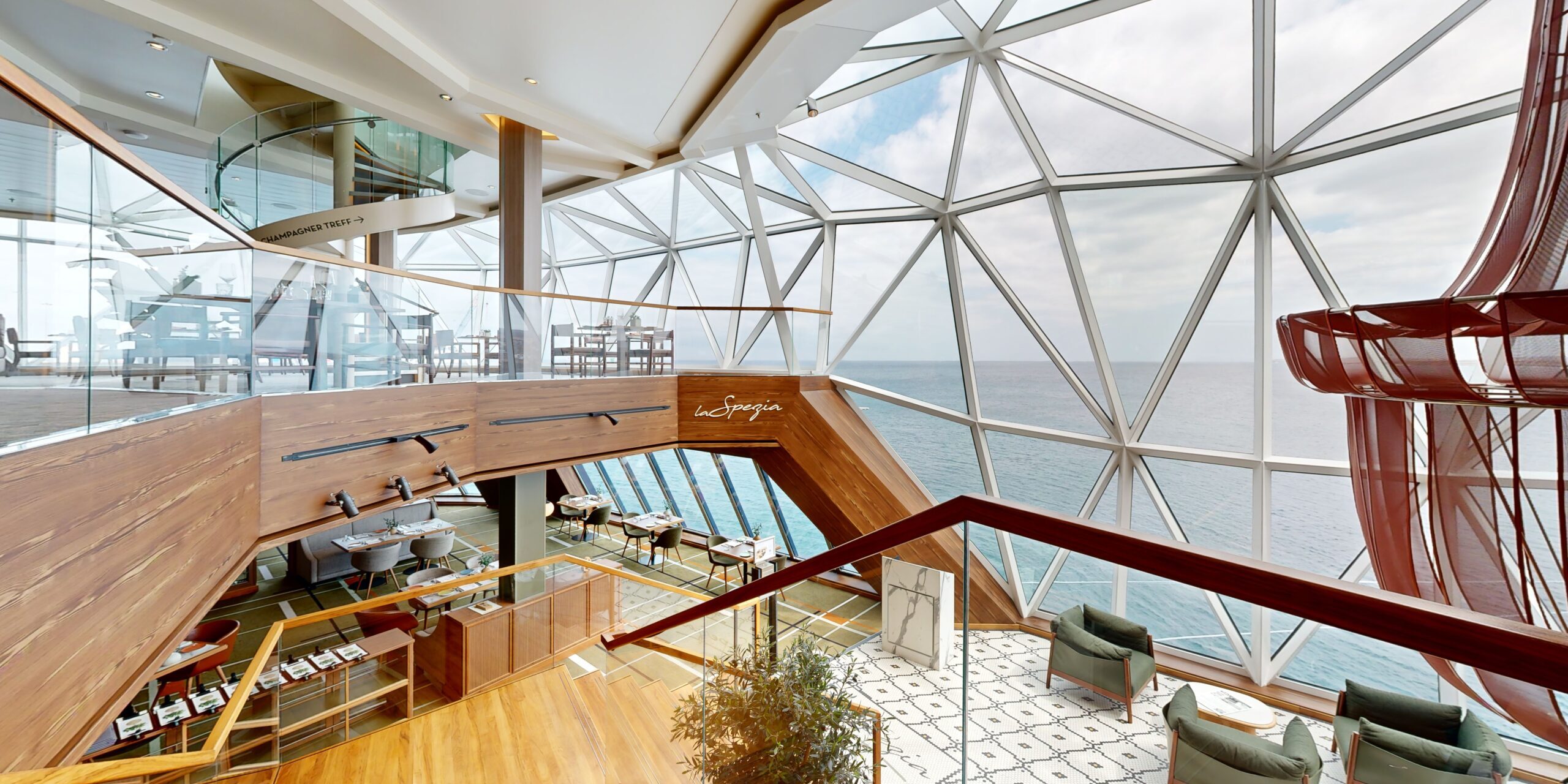
How Cruise Booking Behavior Is Changing — and What It Means for the Industry
by Liquid Ambient | July 2026
The cruise industry is booming like never before. According to the CLIA State of the Cruise Industry Report 2025, 34.6 million people took a cruise in 2024 — a record high. For 2025, 37.7 million passengers are expected, and CLIA projects 41.9 million by 2028. J.P. Morgan Research estimates the industry will capture approximately 3.8% of the global vacation market — valued at $1.9 trillion — by 2028.
But behind these growth figures lies a profound shift: who is booking, how they book, and above all, what they want to see and experience before booking has changed fundamentally over the past two to three years.
1. Who Books a Cruise Today — and Why It Changes Everything
Cruising was long seen as the domain of Baby Boomers. That picture no longer holds. According to CLIA 2025, 36% of all cruise passengers are now under 40. Millennials and Gen Z are the fastest-growing booking segments — and they behave as consumers in fundamentally different ways from older generations.
A study by loyalty technology provider arrivia (September 2025, n=4,500) found that 36% of Millennials plan to cruise within the next two years — the highest share of any age group. Carnival also confirmed in its Q1 2025 earnings call that “new-to-cruise” bookings increased by over 30% year-on-year.
What does this mean in practice? This new booking cohort is digitally native. They don’t research with brochures — they use smartphones and social media. They compare, zoom in, get convinced visually — or click away.
“Gen Z and Millennial search habits are changing rapidly, meaning searches via social media are becoming the go-to over traditional search engines.” — The PHA Group, 2024
2. What Actually Drives the Booking Decision: Ship or Destination?
A question frequently debated in the industry: do guests book a cruise because of the itinerary — or because of the ship?
The data is clear, but nuanced. According to a survey by Cruiseline.com and Shipmate among over 7,000 respondents (2024), destination ranks first at 36.6% as the primary decision factor — ahead of price (26.4%), cruise line (22.9%), and the ship itself (8.1%).
At first glance, this sounds discouraging for those who believe the ship is the sales argument. But these numbers only tell part of the story.
In the luxury and premium segment, this balance shifts considerably. When a guest spends €5,000, €15,000 or €90,000 on a suite, they are not primarily booking a destination — they are booking an experience, an atmosphere, a product. The ship becomes the hotel, the status symbol, the deciding factor.
The growing investment by cruise lines in the ship as an experiential space — from Royal Caribbean’s Icon of the Seas to the new builds by Four Seasons Yachts, Explora Journeys or Ulyssia — shows that the industry itself has long understood that the ship carries the decisive differentiation.
3. The Digital Research Process: What Guests Want to See Before Booking
This is perhaps the most important shift of recent years — and one the industry still underestimates.
Before: Travel agency, brochure, word of mouth. Guests trusted the advisor who knew the ship.
Today: Independent research online. According to CLIA, 50.8% of cruise passengers now book directly online with the cruise line. A further 12.6% book via a travel agency website. Less than a third still books through a personal advisor.
This means: the digital presentation of the product is today’s most important sales tool. Photos, videos, reviews — and increasingly: interactive, immersive content.
What guests want to see in advance:
- Cabin size and sense of space: How large is the cabin really? Does a double bed fit comfortably? Is the bathroom narrow?
- Outdoor areas: Pool, sun deck, views — what condition are they in, how busy do they get?
- Dining: What is the atmosphere like in the restaurants?
- Public spaces: Spa, fitness, lounges — what will I actually find on board?
Photos answer these questions only partially. They are carefully selected, shot with wide-angle lenses, and show the best — not the real. Videos are dynamic but not interactive. Guests cannot explore at their own pace, move in their own rhythm, or choose the perspective that matters to them.
4. Are 3D Virtual Tours Actually Important? An Honest Assessment
Yes — but with an important caveat: the market for cruise ships is still in its early stages. That makes the topic all the more relevant.
For hotels, there is already solid data:
- Hotels with virtual tours see booking increases of 16% to 67% (industry studies)
- Properties with immersive 3D tours achieve 14% to 48% more booking conversions compared to those using 2D imagery only (industry studies)
- Website visitors spend 5 to 10 times longer on pages with 3D tours than on pages with static images
- 75% of travelers say virtual tours are helpful in their accommodation booking decision (industry studies)
- Listings with virtual tours receive twice the engagement compared to those without, according to a Google study
These figures come from the hotel industry — and that is no coincidence. Direct, large-scale studies on 3D tours of cruise ships are rare so far. The reason is simple: complete 3D Digital Twins of large cruise ships — all decks, all cabin categories, all public spaces as one connected, navigable model — were until recently a technical and logistical exception, not a standard. The data follows reality: what does not exist cannot be measured. That is changing now.
What we do know: Guests want to understand a ship before they book. They don’t want to imagine — they want to see. And guests who have virtually walked a ship arrive on board with an entirely different quality of anticipation and expectation.
What this means for booking conversion: A 3D Digital Twin removes uncertainty. Uncertainty is the biggest enemy of the booking decision — especially at high price points. A guest spending five figures on a luxury suite does not want to imagine what the cabin is like. They want to know.
5. How Booking Behavior Will Continue to Change
Several developments are clearly emerging:
Younger booking cohorts will increasingly dominate. Millennials and Gen Z will become the primary booking segment for premium and luxury cruises over the next five years. They bring higher digital expectations, lower brand loyalty, and a lower tolerance for information gaps in the booking process.
Shorter decision cycles. Demand for shorter cruises (under five days) is growing strongly, particularly among first-time cruisers. Shorter trips mean faster decisions — making the quality of the digital first impression even more critical.
AI and personalization. Booking platforms will increasingly enable personalized experiences — from cabin selection to restaurant recommendations. Digital Twins with integrated personalization layers could become the next industry standard.
Travel advisors remain relevant — but differently. According to CLIA, nearly 80% of all cruisers use travel advisors for their booking — but they arrive already informed. The advisor confirms the decision; they make it alone less and less. This means: what the guest has seen online before the consultation shapes the expectation the advisor must then meet.
6. What This Means for Cruise Lines
The message is straightforward: the product must be digitally experienceable — before the gangway goes down.
A cruise line that invests in new ships, extensive refits, or exclusive dining concepts has only truly communicated that investment when the prospective guest can experience it — without being on board.
Photos show the best. Videos show movement. A complete 3D Digital Twin shows the truth — and that is exactly what builds trust.
For luxury and ultra-luxury cruise lines, this point is even more critical. A guest investing a seven-figure sum in a residence on Ulyssia, or paying a five-figure daily rate for a Four Seasons Yachts suite, has every right to know the product fully in advance.
The question is no longer whether 3D tours of cruise ships influence the booking decision.
The question is: why isn’t the ship walkable yet?
Why Liquid Ambient Is the Right Partner
The question many cruise lines ask: who can actually deliver this?
A complete 3D Digital Twin of a large cruise ship is not a photo shoot and not a video production day. It is a logistically and technically complex project — with hundreds of cabins across dozens of categories, narrow corridors, mirrored surfaces, shifting light conditions, and a ship that moves.
Liquid Ambient is, to the best of current knowledge, the only agency to have produced entire large cruise ships as complete, connected 3D Digital Twins — not individual rooms, not selected decks, but the entire ship.
The reference projects speak for themselves:
- Entire AIDA Cruises fleet — every ship, fully digitized
- Mein Schiff Relax (TUI Cruises) — live within days of shipyard handover
- Mein Schiff Flow (TUI Cruises) — live within days of Fincantieri handover in Monfalcone
- Mein Schiff 7 (TUI Cruises) — scanned during a live crossing with 2,900 guests on board, at sea between the Canary Islands and Hamburg
That last project perhaps best illustrates what sets Liquid Ambient apart: workflows have been developed that make it possible to scan a ship in full operation — without dry dock, without empty corridors, without interrupting the cruise schedule. Engine vibrations, mirrored surfaces in the spa, guests walking into frame — all of it is solvable, when the right processes are in place.
For cruise lines that want to offer their guests a complete digital experience of their ship before they step on board, there is currently no comparable partner.
The booking decision happens before the gangway. Liquid Ambient makes sure the ship is already there waiting.
Sources
- CLIA State of the Cruise Industry Report 2025, Cruise Lines International Association (cruising.org)
- J.P. Morgan Research: Cruise Industry Outlook (jpmorgan.com)
- Cruiseline.com / Shipmate Member Survey 2024, via Travel Industry Wire
- arrivia: “View from the Cabin: The Trends Shaping the Modern Cruise Experience”, September 2025
- Morning Consult: “How Gen Z and Millennials Feel About Cruise Lines”, February 2025
- EY-Parthenon: “How Cruise Lines Can Win Gen Z”, 2023/2026
- Internova Travel Group Research, January 2026, via Recommend.com
- AAA: “Record 19 Million Americans Projected to Cruise This Year”, January 2025
- The PHA Group: “How to Market to Cruise Ship Passengers”, December 2024
- Photo: La Spezia-TUI MS7
FAQ
Häufige Fragen rund um Matterport-Touren auf Kreuzfahrtschiffen, 3D-Digitale-Zwillinge für Reedereien und die Zusammenarbeit mit LIQUID AMBIENT:
Was ist ein digitaler Zwilling eines Kreuzfahrtschiffs?
Ein digitaler Zwilling eines Kreuzfahrtschiffs ist eine vollständige, maßstabsgetreue 3D-Kopie des gesamten Schiffs – von der Kabine über die Außendecks bis zu den Crew-Bereichen. Erstellt mit dem Matterport Pro3-Scanner und LiDAR-Technologie, ermöglicht er eine realistische, navigierbare Online-Tour. Passagiere, zukünftige Crew-Mitglieder und Reisebüros können das Schiff virtuell erkunden – dies verbessert die Customer Journey und steigert nachweislich Buchungsraten und Conversion.
Welche Kreuzfahrtschiffe hat LIQUID AMBIENT bereits digitalisiert?
Liquid Ambient hat z.B. die gesamte AIDA-Flotte – inklusive AIDAnova und AIDAcosma (Helios-Klasse), AIDAprima und AIDAperla (Hyperion-Klasse) sowie mehrere Schiffe der Sphinx-Klasse – als vollständige 3D-Digitale-Zwillinge erfasst. Für TUI Cruises wurde die Mein Schiff Relax digitalisiert; die Mein Schiff Flow und weitere Schiffe der TUI-Flotte sind bereits in Umsetzung.
Warum ist das Matterport-Scanning auf Schiffen so schwierig?
Wie lange dauert der Scan eines kompletten Kreuzfahrtschiffs?
Was kostet ein Matterport-Scan eines Kreuzfahrtschiffs?
Kann LIQUID AMBIENT auch Hotels und andere Hospitality-Immobilien scannen?
Ist ein Scan auch während des Werftaufenthalts (Trockendock) möglich?
Über Liquid Ambient
Seit über 15 Jahren zählt Liquid Ambient zu den Technologieführern im Bereich 360°- und 3D-Touren. Das Unternehmen mit Sitz in Stuttgart, Baden-Württemberg, realisiert maßgeschneiderte virtuelle Erlebnisse für internationale Hotelketten, Reedereien und touristische Destinationen. Modernste Scan- und Rendering-Technologien – darunter Matterport Pro3, LiDAR und High-End-CGI – führen zu mehr Sichtbarkeit, besserer Conversion Rate und einer optimierten Customer Journey. www.liquidambient.com
Planen Sie ein Schiffs- oder Hotelprojekt?
Ob Werftaufenthalt im Trockendock, Turnaround Day oder laufender Betrieb – wir entwickeln das passende Logistik- und Scan-Konzept für Ihr Vorhaben.